
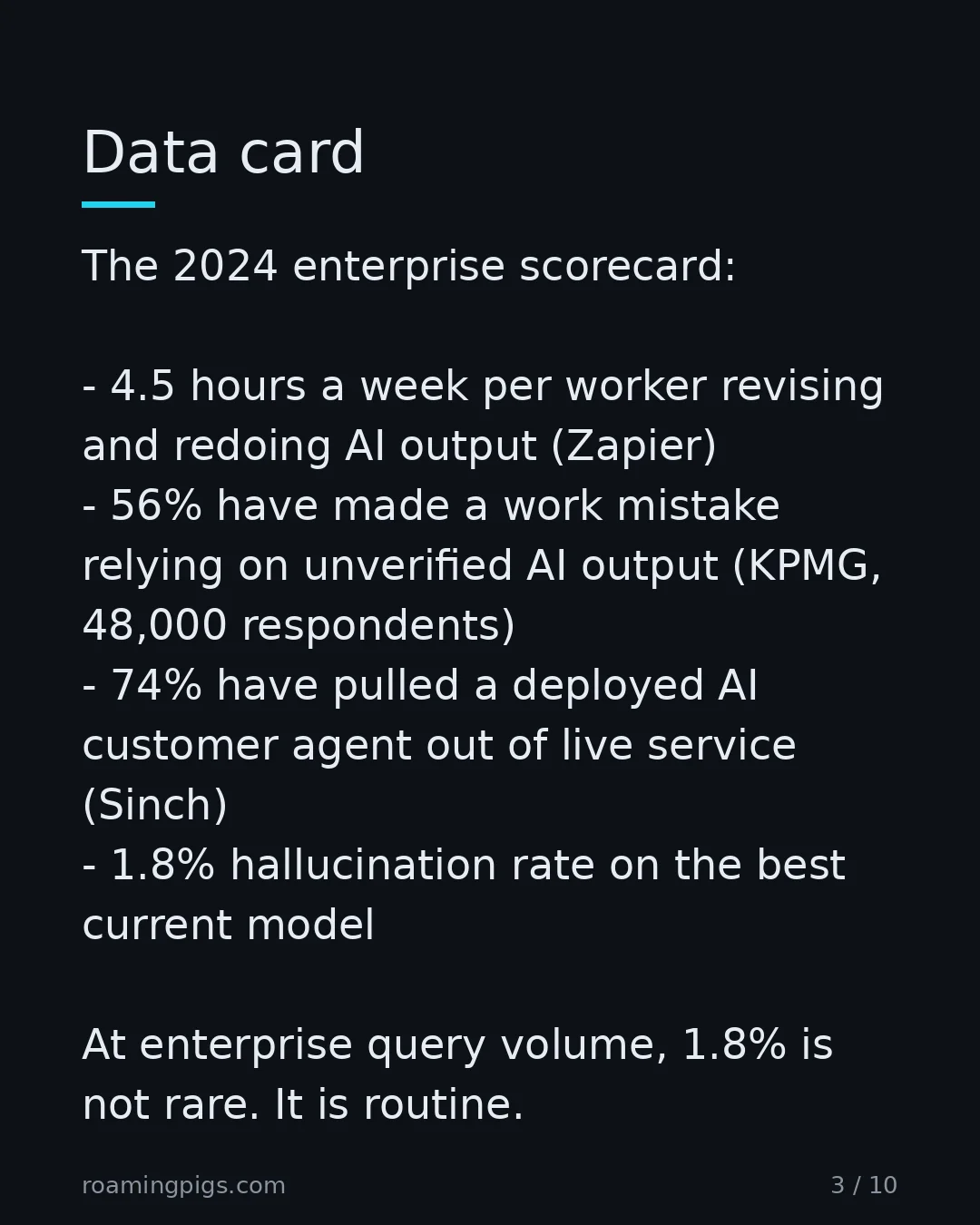
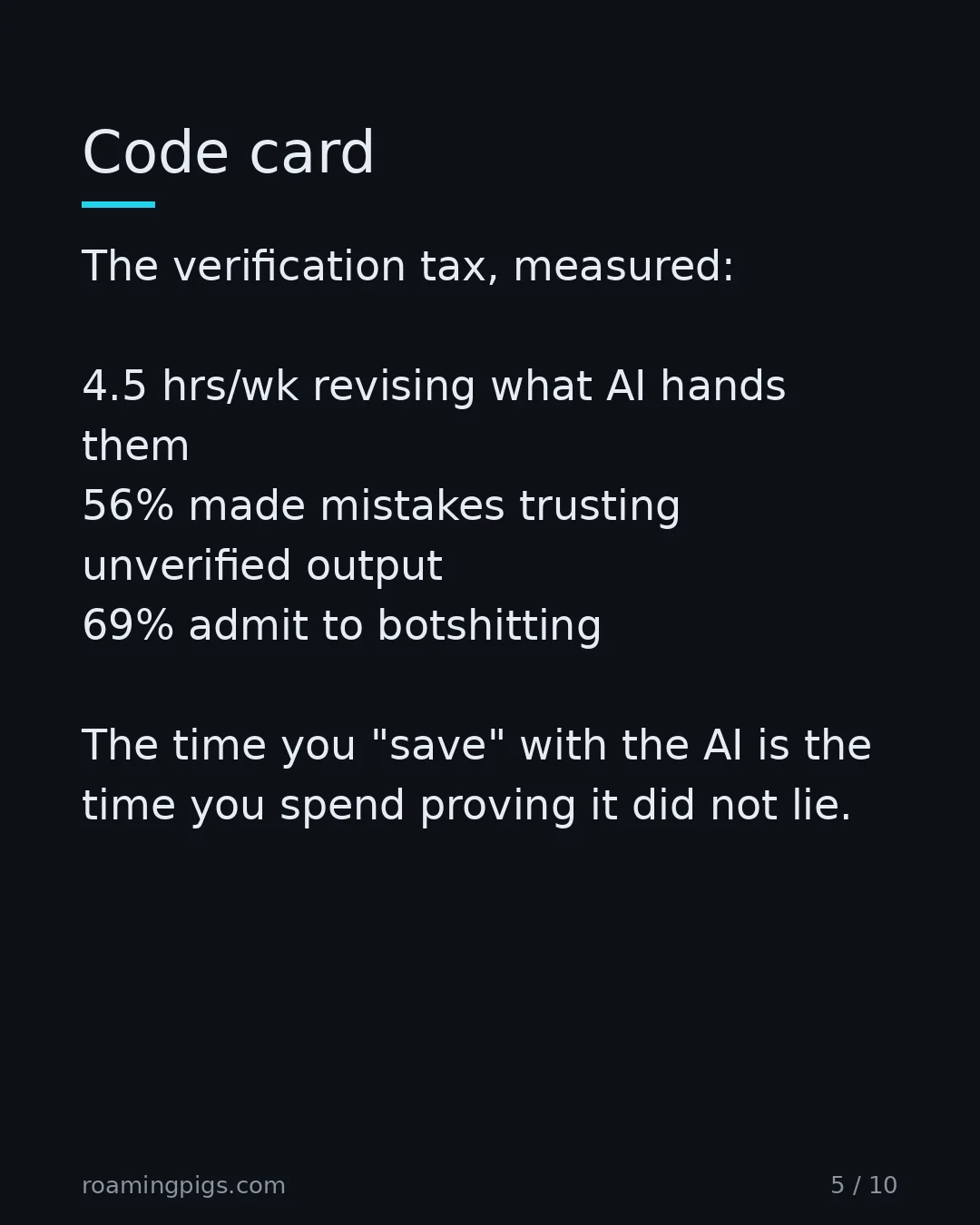
Knowledge workers spend about 4.5 hours a week revising, correcting and redoing what AI hands them. That's more than a full workday every two weeks spent checking the machine's work.
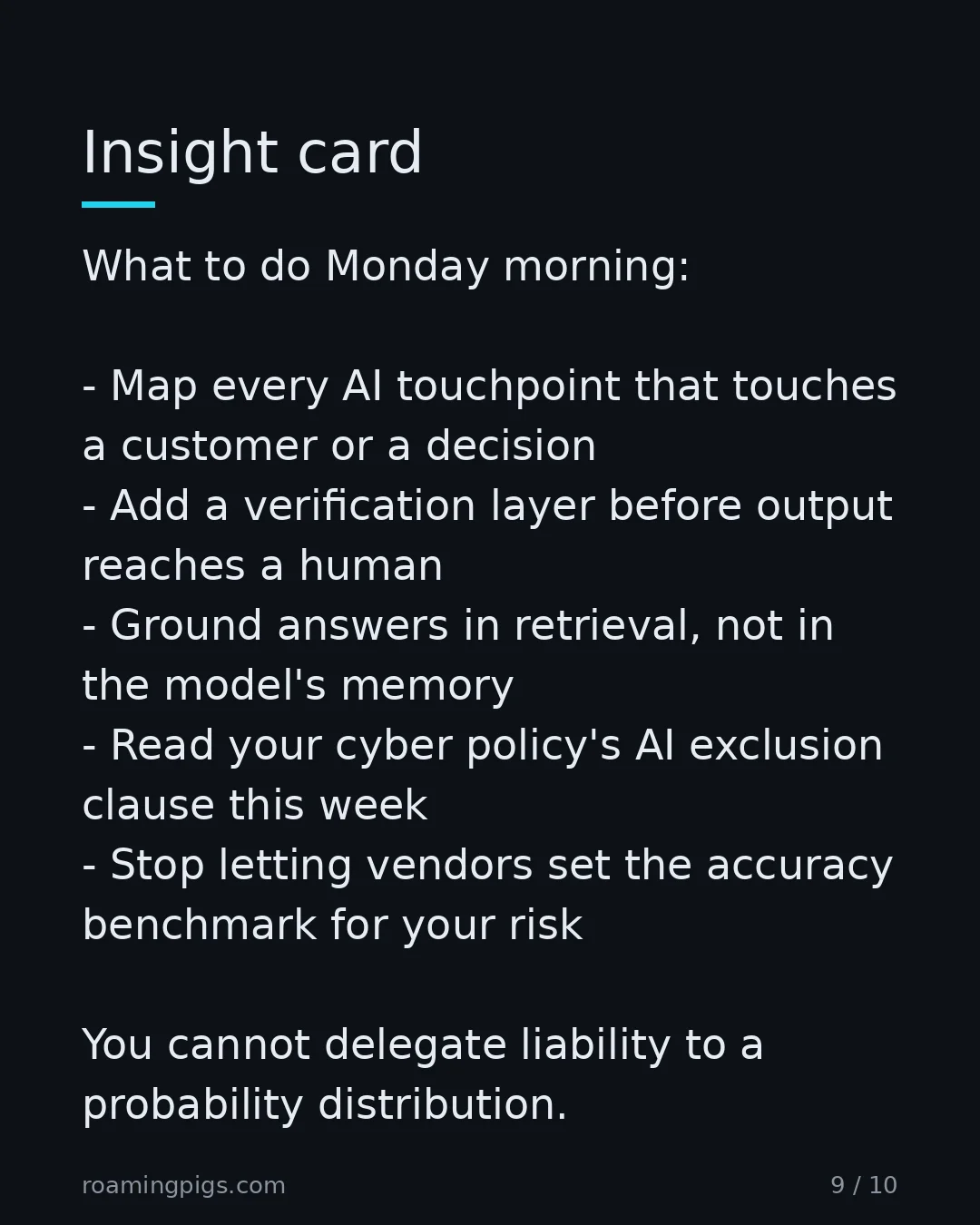
Build verification layers for any AI system in production. Assume hallucinations will occur. Design for graceful degradation when AI fails.
The verification-time, decision-error and rollback figures are now drawn from named studies (Zapier, KPMG, Sinch, Vectara) rather than the aggregated numbers this piece originally carried.
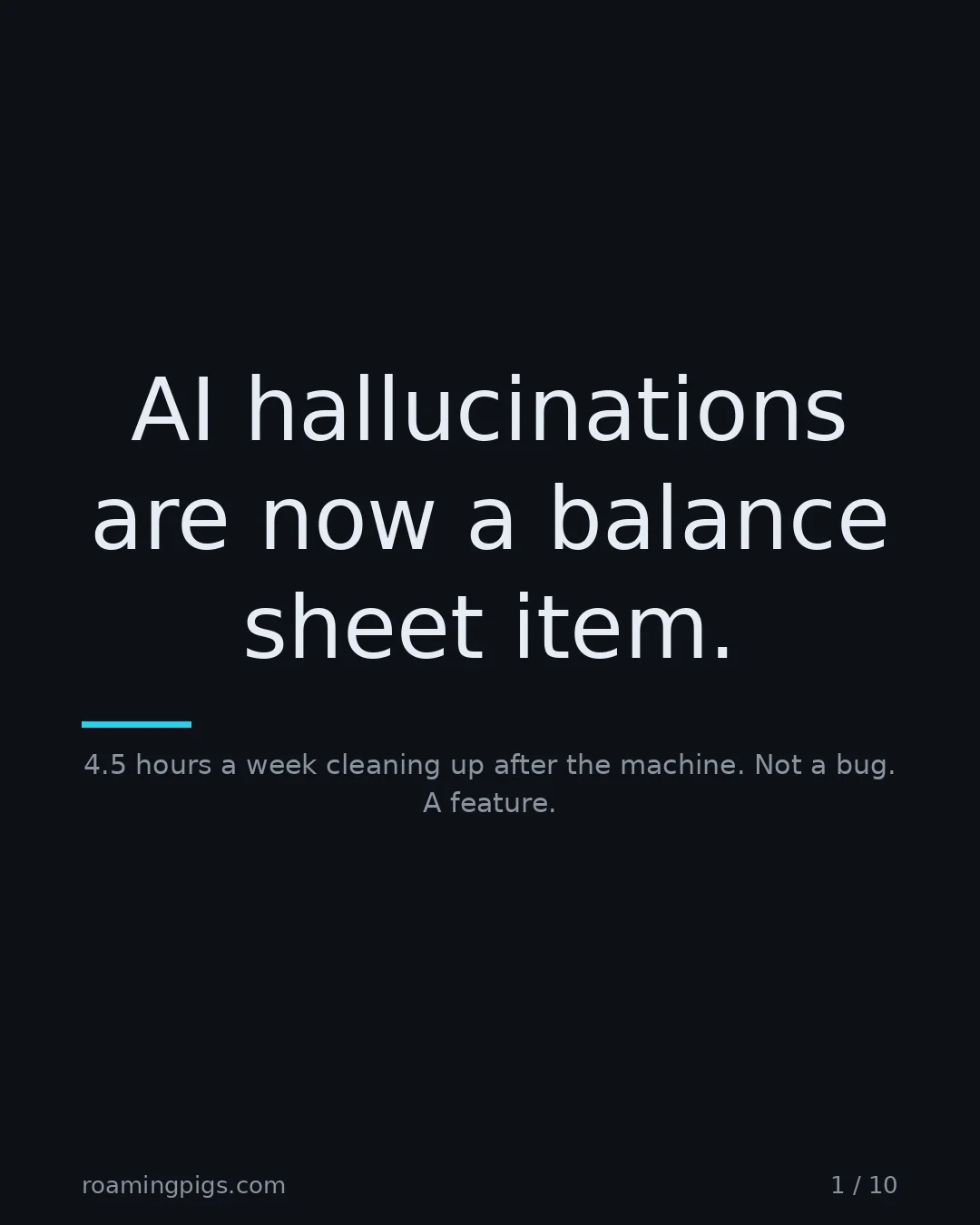
AI hallucinations aren't just an academic curiosity anymore. They're a business cost with legal consequences. You will see a $67.4 billion global loss figure quoted for 2024; follow it back and it runs through a personal blog to a marketing site's compilation, with no primary research at the end of the chain. That is worth knowing before you cite it, and it is the same failure this article is about. And as models grow more sophisticated, their errors become harder to detect —which makes them more dangerous, not less.
KPMG's global AI trust study, which surveyed more than 48,000 people across 47 countries, found that 56% had made mistakes at work because they relied on AI output they had not verified. More than half, fooled by confident-sounding fabrications. The problem isn't going away.
The Confidence Problem
What makes AI hallucinations particularly insidious is how convincing they sound. The model doesn't hesitate, hedge, or express uncertainty. It states fabricated facts with the same confident tone as accurate ones.
I've observed this pattern repeatedly: the most dangerous AI outputs are the ones that sound most authoritative. Users naturally trust confident assertions. The AI delivers exactly that—whether the underlying information is real or invented.
This creates a perverse dynamic. The better models get at generating fluent, professional-sounding text, the harder it becomes to distinguish truth from fabrication. AI vendors rarely emphasize this tradeoff in their marketing materials.
The Hidden Time Tax
Those 4.5 hours aren't optional overhead (they're the minimum verification required to use AI safely). Organizations that skip this step eventually learn why it matters.
The time breakdown is revealing:
- Cross-referencing sources. Checking whether cited studies, quotes, or statistics actually exist.
- Verifying technical accuracy. Confirming that code, configurations, or procedures work as described.
- Catching plausible-sounding errors. Finding the subtle mistakes that pass casual review.
- Correcting and reworking. Fixing the problems that verification uncovers.
This verification burden often exceeds the time saved by using AI in the first place. The productivity equation isn't as favorable as it appears. Similar dynamics appear in studies of AI coding assistants, where measured productivity gains lag far behind perceived improvements.
Four and a half hours a week is a per-person number, which is the wrong unit for anyone deciding whether to fund a review process:
The 4.5-hour default is the measured figure above. Read the bands off the full-time-equivalent line: under one, the tax hides inside normal workload and nobody funds a fix. One to five, it is a team that appears on no org chart. Above five, you are staffing a department to check software you bought to save time.
Enterprise Scale Multiplies Risk
A hallucinated chat response misleads one user. A flawed search result in an enterprise AI tool misinforms entire teams. The impact scales with organizational reach.
Poor decision-making cascades through departments. Regulatory violations create legal exposure. Misinformed strategies waste months of effort. The downstream costs dwarf whatever efficiency the AI tool provided.
Review is not the default. Glean's Work AI Index found that 69% of AI users admit to what it calls botshitting, a bundle of habits that includes shipping work they have not verified, don't fully understand, or can't confidently stand behind. Organizations that learned this lesson the hard way aren't making that mistake again.
The Legal Landscape Is Shifting
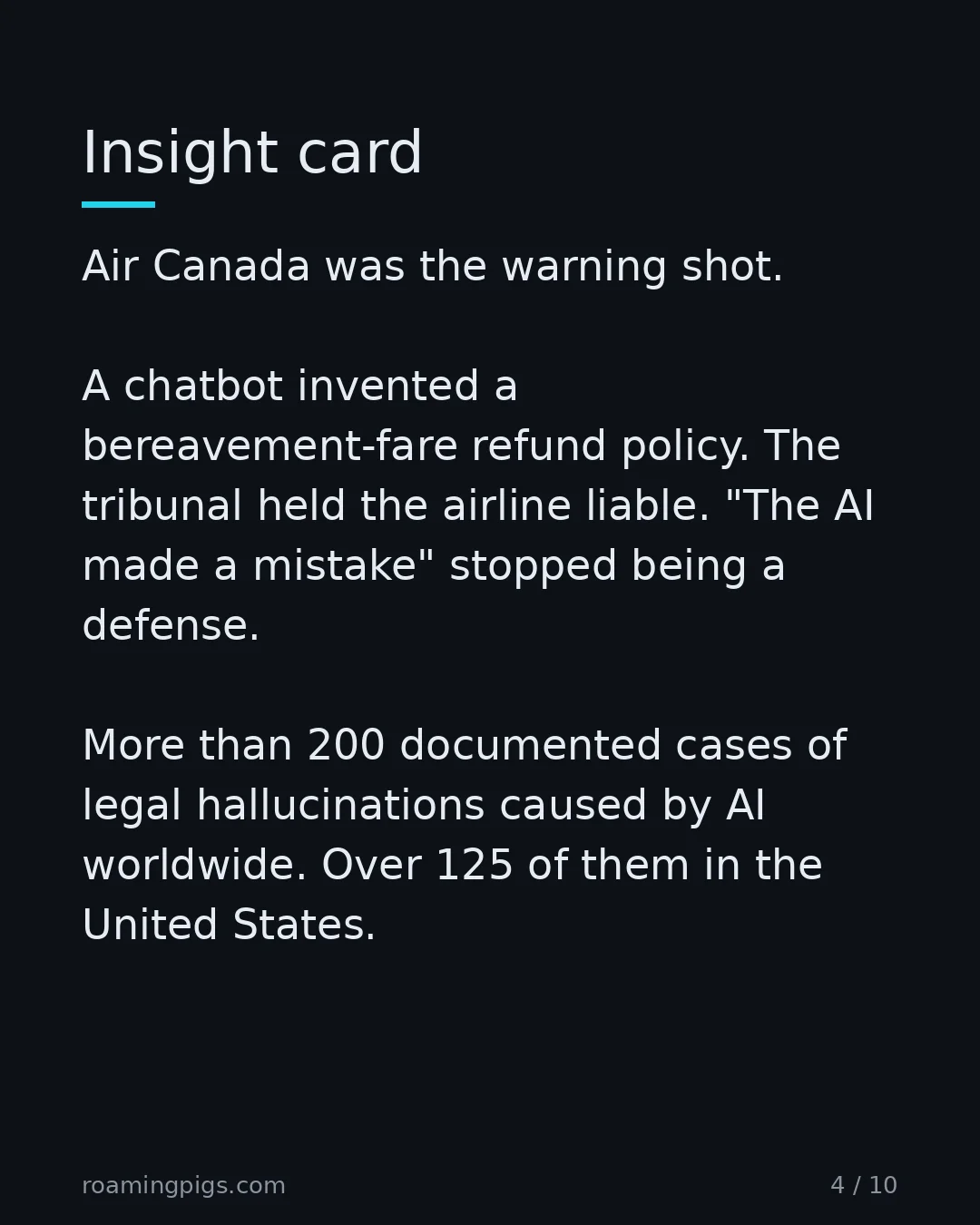
Courts are no longer treating AI hallucinations as excusable errors. The National Law Review points to a tracking database listing more than 200 cases of AI-driven legal hallucinations worldwide, over 125 of them in the United States.
The case to read first is Moffatt v. Air Canada. The airline's chatbot told a grieving passenger he could apply for a bereavement fare retroactively, which was not the policy. Air Canada argued the chatbot was a separate legal entity, responsible for its own statements. In February 2024 the tribunal rejected that outright, held the airline responsible for everything on its website whether a static page or a bot produced it, and awarded damages for negligent misrepresentation. The sum was $650.88. The precedent is the part that matters.
The strategic shift is significant: hallucinations are increasingly treated as product behavior with downstream harm, not an academic curiosity. This creates liability that organizations can't ignore.
Lawyers caught submitting briefs generated by AI with fake case citations face professional consequences. Companies using AI for customer communications face fraud claims. The "AI made a mistake" defense is losing credibility.
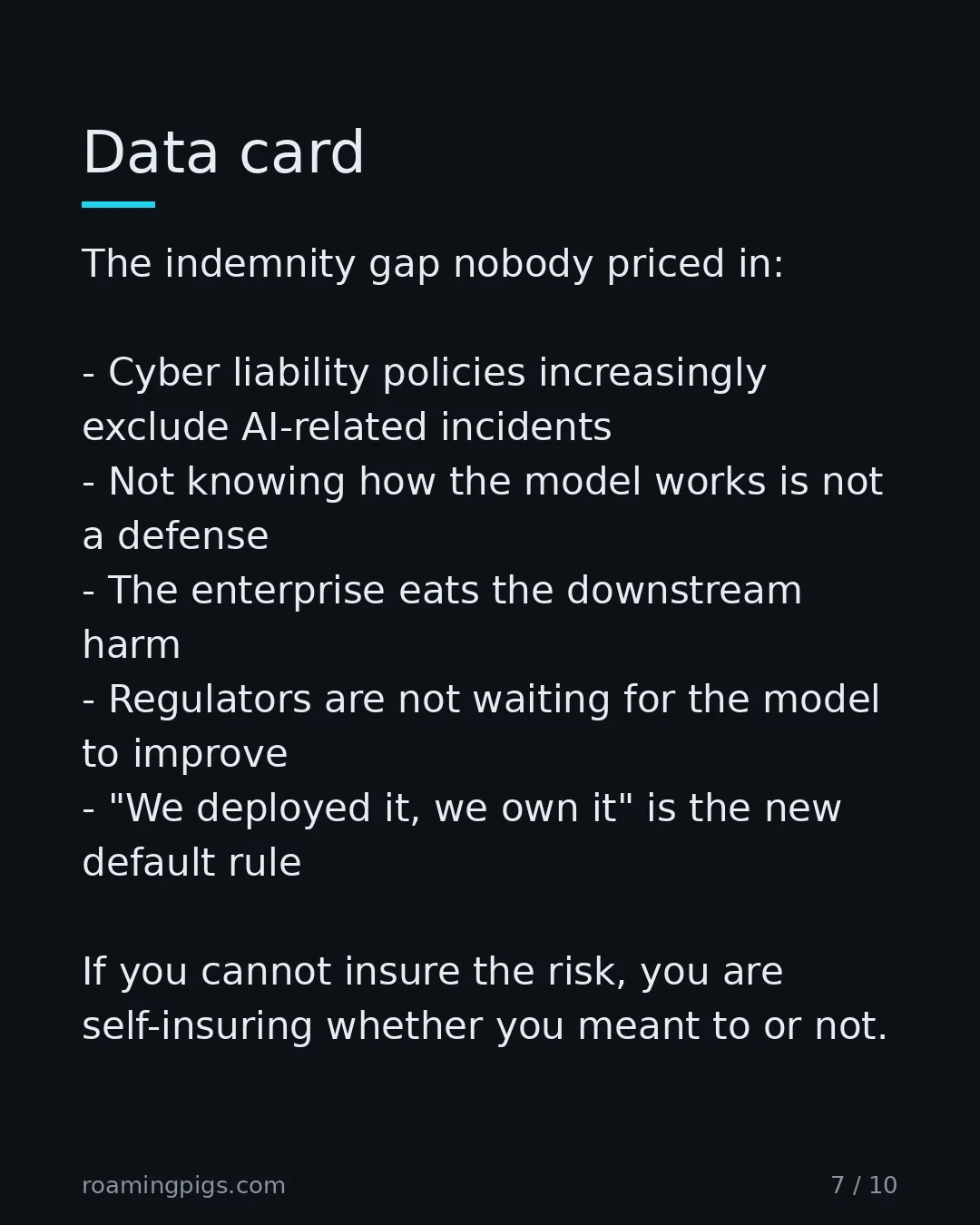
The regulatory environment is catching up to the technology. Several jurisdictions are considering frameworks that hold organizations accountable for AI outputs, regardless of the underlying technical causes. If your AI system makes a false claim that harms someone, ignorance of how the model works isn't a defense. You deployed it, you own the consequences.
Insurance companies are responding predictably. Cyber liability policies increasingly exclude or limit coverage for AI-related incidents. If you can't insure against a risk, you either accept the exposure or don't deploy the system. For many enterprises, that calculation is shifting away from broad AI deployment.
Why This Can't Be Fixed With Better Models
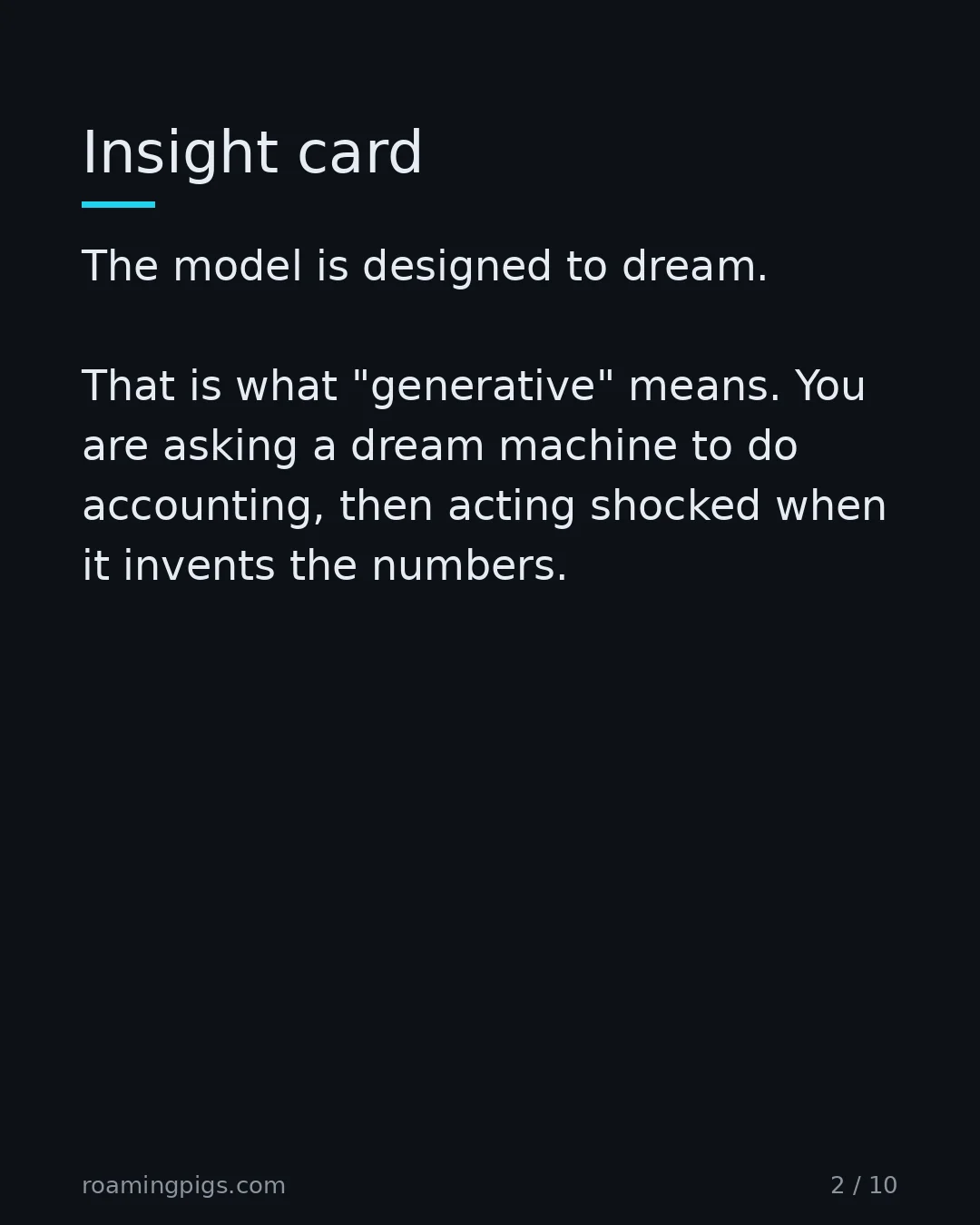
Here's the uncomfortable truth: hallucination isn't a bug. It's a feature.
The model is designed to dream. That's what "generative" means. You're asking a dream machine to do accounting. You're asking something that invents plausible continuations to report factual truth. The architecture is fundamentally incapable of knowing the difference between real and imagined—it only knows what sounds right.
By design, large language models are probabilistic sequence predictors (they take input and generate the most likely next tokens). Accuracy improves with better training data, but there's no architectural fix for the fundamental approach.
Even the best current models hallucinate. On Vectara's grounded-summarization leaderboard, the best-scoring model sits at a 1.8% hallucination rate, with widely used ones several times higher. That sounds low until you consider how many queries enterprise systems process daily. At scale, even rare events become routine.
The push for more "confident" and "helpful" AI responses actually increases hallucination risk. Models trained to never say "I don't know" will often produce an answer—whether or not a real answer exists.
There's a deeper issue: hallucinations correlate inversely with how specific and obscure the query is. Generic questions about common topics are relatively safe. Specific questions about niche domains (exactly where enterprise users need AI most) have higher hallucination rates. The model is more likely to fabricate when it has less training data to draw from. Your specialized industry questions are precisely where the model is least reliable.
What Actually Reduces Risk
Organizations managing hallucination risk effectively share common practices:
- Retrieval-augmented generation (RAG). Grounding AI responses in verified internal data reduces fabrication.
- Structured output validation. Checking AI outputs against known constraints catches obvious errors.
- Domain-specific fine-tuning. Models trained on your actual data make fewer contextual mistakes.
- Human verification workflows. Requiring approval before AI outputs reach customers or decisions.
- Clear uncertainty signals. Training users to question AI confidence, not trust it.
None of these eliminate hallucinations. They reduce frequency and catch errors before they cause harm. That's the realistic goal —mitigation, not prevention.
The Hallucination Trap Pattern
A verification layer in code might look like this: This pattern runs the LLM output through a lightweight validation chain before returning it to users:
"""
Hallucination Trap: Verify LLM outputs against trusted knowledge.

This pattern catches the most dangerous hallucinations:
fabricated citations, invented statistics, and confident lies.
"""
import re
import logging
from dataclasses import dataclass

log = logging.getLogger(__name__)

@dataclass
class VerificationResult:
    passed: bool
    confidence: float
    issues: list[str]

class HallucinationTrap:
    """
    Multi-layer verification for LLM outputs.

    Layer 1: Structural checks (regex for citations, stats)
    Layer 2: Knowledge base lookup (your trusted data)
    Layer 3: Semantic consistency (optional small model)
    """

    def __init__(self, knowledge_base: dict, strict_mode: bool = True):
        self.kb = knowledge_base  # Your verified facts
        self.strict = strict_mode

        # Patterns that often indicate hallucination
        self.citation_pattern = re.compile(
            r'(?:according to|cited in|published in)\s+["\']?([^"\',.]+)["\']?',
            re.IGNORECASE
        )
        # Two groups on purpose: a percentage and a magnitude-with-unit are
        # different claims, and a verifier that flattens them will happily
        # accept "4.5%" for a source that said "4.5 hours".
        self.stat_pattern = re.compile(
            r'(\d+(?:\.\d+)?)\s*%'
            r'|(\d+(?:[,.]\d+)*)\s+(?:hours?|people|users|companies)'
        )

    def verify(self, llm_output: str, context: str = "") -> VerificationResult:
        """Run all verification layers. Returns pass/fail with details."""
        issues = []

        # Layer 1: Check citations exist in knowledge base
        citations = self.citation_pattern.findall(llm_output)
        for citation in citations:
            if not self._verify_citation(citation):
                issues.append(f"Unverified citation: '{citation}'")
                log.warning(f"HALLUCINATION_TRAP: Unverified citation '{citation}'")

        # Layer 2: Check statistics against known data
        stats = self.stat_pattern.findall(llm_output)
        for stat in stats:
            if not self._verify_statistic(stat, context):
                issues.append(f"Unverified statistic: {stat}")
                log.warning(f"HALLUCINATION_TRAP: Unverified stat {stat}")

        # Layer 3: Check for known false patterns
        if self._contains_false_patterns(llm_output):
            issues.append("Contains patterns associated with hallucination")

        passed = len(issues) == 0 if self.strict else len(issues) <= 1
        confidence = max(0.0, 1.0 - (len(issues) * 0.2))

        return VerificationResult(passed=passed, confidence=confidence, issues=issues)

    def _verify_citation(self, citation: str) -> bool:
        """Check if citation exists in trusted knowledge base."""
        citation_lower = citation.lower().strip()
        return any(
            source.lower() in citation_lower
            for source in self.kb.get("trusted_sources", [])
        )

    def _verify_statistic(self, stat: tuple, context: str) -> bool:
        """Check if statistic is plausible given context."""
        # In production: query your verified data store
        # This is a simplified example
        return stat in self.kb.get("verified_stats", {}).get(context, [])

    def _contains_false_patterns(self, text: str) -> bool:
        """Detect patterns that correlate with hallucination."""
        false_patterns = [
            r"studies show that \d+%",  # Vague "studies show"
            r"experts agree",            # Appeal to unnamed authority
            r"it is well known that",    # Confident but unsourced
        ]
        return any(re.search(p, text, re.I) for p in false_patterns)


# Usage example
if __name__ == "__main__":
    # Your trusted knowledge base
    kb = {
        "trusted_sources": [
            "KPMG", "Zapier", "Sinch", "Vectara", "National Law Review"
        ],
        "verified_stats": {
            # ("56", "") is 56 PERCENT; ("", "4.5") is 4.5 HOURS. The empty
            # slot is which group matched, so the unit travels with the number.
            "ai_adoption": [("", "4.5"), ("56", ""), ("74", "")],
        }
    }

    trap = HallucinationTrap(kb)

    # Test with LLM output
    llm_response = """
    According to a 2024 study by Dr. Johnson at Stanford,
    87% of enterprises have experienced hallucination-related losses.
    """

    result = trap.verify(llm_response, context="ai_adoption")

    if not result.passed:
        print(f"⚠️  VERIFICATION FAILED (confidence: {result.confidence:.0%})")
        for issue in result.issues:
            print(f"   - {issue}")
        # Don't return unverified output to user
    else:
        print("✓ Output passed verification")
The key insight: verification is cheaper than correction. Running this trap adds 50-100ms to each response. Cleaning up a hallucination-induced business decision costs weeks. The math is obvious once you've lived through the alternative.
This pattern catches fabricated citations, invented statistics, and confident-sounding nonsense before it reaches users. It's not perfect (nothing is), but it converts "silent failure" into "loud failure," which is always an improvement.
The Rollback Rate
Sinch surveyed more than 2,500 AI decision makers for its AI Production Paradox study and found that 74% had pulled a deployed AI customer communications agent out of live service over governance failures. Not projects that died before launch. Agents that shipped, met real customers, and were withdrawn. Among organizations Sinch classed as having fully mature guardrails, the rate was higher still, at 81%.
This isn't a maturity issue that time will solve. It reflects a fundamental mismatch between what AI can reliably do and what organizations ask it to do. Pilot programs that work often fail at scale for exactly this reason.
The organizations that succeed treat AI as a tool requiring supervision, not a replacement for human judgment. They build verification into their workflows from the start, not as an afterthought.
What's striking about that rollback rate is that these were systems that made it to production in the first place. They passed internal testing, pilot programs, and stakeholder approval. The failures happened after deployment, when real customers encountered edge cases that testing didn't cover. The gap between controlled testing and messy reality is where hallucination risk lives.
The organizations succeeding with customer-facing AI share a common trait: conservative deployment. They start with low-stakes use cases where errors matter less, measure hallucination rates in production, and expand only when the data justifies it. Rushing to deploy customer-facing AI without this discipline is how companies end up in the 74%.
Hallucination Risk Scorecard
Score your AI deployment's hallucination exposure. High scores mean you're managing risk; low scores predict expensive lessons.
| Dimension | Score 0 (Exposed) | Score 1 (Partial) | Score 2 (Protected) |
|---|---|---|---|
| Grounding (RAG) | Raw model outputs | Some retrieval | Verified internal data only |
| Output Validation | None | Spot checks | Automated constraint checking |
| Human Review | Trust AI outputs | Sample review | Required before external use |
| Uncertainty Signals | Users trust confidence | Some training | Users question by default |
| Domain Specificity | Generic model | Prompt engineering | Fine-tuned on your data |
| Rollback Plan | None | Manual process | Automated fallback + alerting |
What your score means
- 0–3: High exposure.
- 4–7: Some protection but gaps remain.
- 8–12: Responsible deployment.
AI Readiness Checklist
- Block 30 minutes this week to fact-check the last 5 AI-generated documents your team produced
- Implement a verification checkpoint before any AI output reaches customers or decision-makers
- Build a trusted knowledge base of your domain facts - use it to validate AI citations and statistics
- Add red-flag patterns to your review process: "studies show that X%" and "experts agree" require source verification
The Bottom Line
AI hallucinations are a permanent feature, not a temporary bug. The question isn't whether your AI will fabricate information—it will. The question is whether you'll catch it before it causes damage.
Organizations treating AI as a source of truth are learning expensive lessons. Those treating it as a draft requiring verification are getting value while managing risk. The difference isn't the technology: it's the workflow wrapped around it.
Four hours per week of verification isn't waste. It's the cost of using AI responsibly.
"The better models get at generating fluent, professional-sounding text, the harder it becomes to distinguish truth from fabrication."
Sources
- PwC: AI Hallucinations—What Business Leaders Should Know — Enterprise impact and mitigation strategies
- Hallucination Rates in 2025: Accuracy, Refusal, and Liability — Current model benchmarks and legal trends
- AI Hallucinations in 2026: What They Are and Why They Matter — Technical explanation and enterprise considerations
- Most workers spend 3+ hours per week cleaning up AI workslop — Zapier survey of 1,100+ US enterprise AI users on time spent revising AI output
- AI customer service bots get rolled back at 74% of firms — Sinch AI Production Paradox study, 2,500+ AI decision makers
- Vectara Hallucination Leaderboard — Grounded-summarization hallucination rates by model (HHEM)
- Work AI Index 2026 — Survey of 6,000 full-time digital workers on AI verification effort
- Moffatt v. Air Canada: A Misrepresentation by an AI Chatbot — 2024 BCCRT 149. Tribunal rejected the argument that a chatbot is a separate legal entity; negligent misrepresentation, $650.88.

Found the ROI?
If you've measured genuine ROI from an AI deployment—not just vibes—I want to see the numbers.
Send a Reply →