
Since 2016, I've evaluated blockchain for client projects exactly 47 times. I've recommended it exactly zero times. Here's the truth: Gartner predicted in 2019 that more than 90% of enterprise blockchain platform implementations would need replacing by 2021, with most efforts stuck short of production. If blockchain infrastructure disappeared tomorrow, the vast majority of products would continue unchanged.
Before adopting blockchain, identify what specific problem it solves better than a database. If you can't answer clearly, you don't need blockchain.



This isn't skepticism. It's experience. I've adopted plenty of technologies that seemed radical at first. But blockchain keeps failing the same simple test: is it better than what we already have? I've shared what I learned evaluating blockchain startups in 2018.
The answer, after 47 evaluations and 15 years of watching the industry: no.
The Promise vs. The Reality
Blockchain was supposed to revolutionize:
- Finance - Decentralized, trustless transactions
- Supply chain - Immutable tracking from source to shelf
- Healthcare - Patient-controlled medical records
- Voting - Transparent, tamper-proof elections
- Real estate - Instant, fraud-proof property transfers
- Identity - Self-sovereign digital identity
It's been 15 years since Bitcoin launched. Where are all these revolutions?
Finance is still dominated by banks. Supply chains still use databases. Healthcare records are still a mess. Voting happens on paper. Real estate still requires lawyers and title companies. Governments and corporations still manage your identity.
The blockchain revolution didn't happen. Not because the technology was suppressed. For every proposed use case, someone asked the obvious question. "Why not just use a database?"
Every Enterprise Blockchain Becomes a Database
I've watched this pattern play out dozens of times:
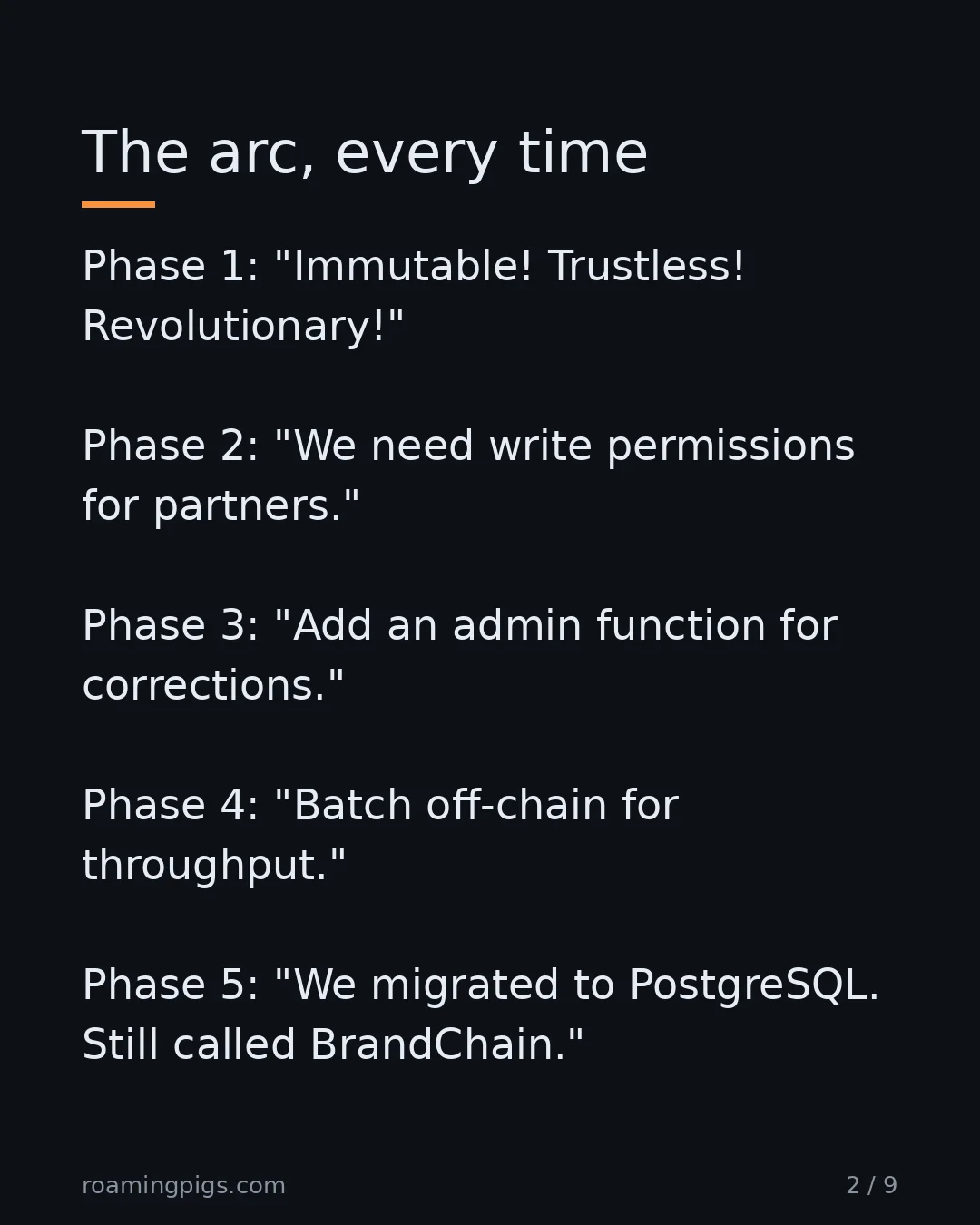
Phase 1: Excitement. "We're going to put our supply chain on the blockchain! Immutable records! Trustless verification! Revolutionary!"
Phase 2: Implementation. "Okay, so we need write permissions for our partners... and we need to be able to correct errors... and the throughput isn't quite what we need..."
Phase 3: Compromise. "We've added a permission layer. And an admin function for corrections. And we're batching transactions off-chain for performance."
Phase 4: Realization. "So we have a permissioned system with centralized admin functions and most processing happening off the chain..."
Phase 5: Quiet pivot. "We've moved to a distributed database architecture. The project is still called [Brand]Chain but it's basically PostgreSQL."
Every enterprise blockchain project I've seen has followed this arc. The features that make a blockchain a blockchain get removed one by one. You end up with a database. Extra steps.
The two flagship cases ran it in public. IBM Food Trust launched in 2018 and Walmart told its leafy-greens suppliers to be on it by 2019, which is about as much commercial force as anyone has ever put behind a distributed ledger. What shipped was a permissioned database run by a consortium: no public chain, no trustless verification, an administrator who can correct a record. The lettuce still gets traced. The blockchain stopped being the reason.
The other one did not survive at all. IBM and Maersk launched TradeLens the same year, pitched as the supply-chain blockchain to end supply-chain blockchains. They announced its discontinuation in November 2022 and it was offline by the end of the first quarter of 2023, after five years and a great deal of money. Maersk's own reason is the whole argument of this article in one sentence: "the need for full global industry collaboration has not been achieved." The technology was never the binding constraint. Getting competitors to agree was.
The most expensive version of this ran at the Australian Securities Exchange, which committed in 2017 to replacing CHESS, its clearing and settlement system, with a distributed ledger built with Digital Asset. Six years in, an independent Accenture review found the thing was not ready. ASX abandoned it in November 2022 and derecognised the capitalised software, taking a charge of A$245-255 million pre-tax. The regulator later sued over what the exchange had told the market about its progress. The replacement now being built is a conventional system. Six years and a quarter of a billion dollars to arrive at the architecture they started with.
The Decentralization Myth
Blockchain's core value proposition is decentralization. No single point of control. No trusted intermediary. The network is the authority.
How's that working out?
Bitcoin mining: According to blockchain.com pool data, a small number of mining pools control the majority of Bitcoin's hash rate. The network sold as decentralized is effectively controlled by a handful of entities. They could collude to manipulate transactions.
Ethereum: After the DAO hack in 2016, the Ethereum community voted to hard-fork the chain and reverse the "immutable" transactions. The supposedly trustless system required trust in community governance. A centralized decision.
Exchanges: Most cryptocurrency activity happens on centralized exchanges like Coinbase and Binance. The decentralized currency ecosystem is dominated by centralized intermediaries. The exact thing blockchain was supposed to eliminate.
Decentralization sounds good in theory. In practice, it either doesn't exist or causes more problems than it solves.
Immutability: A Feature Nobody Wants
Blockchain advocates tout immutability as a key feature. Once something is written to the chain, it can't be changed. Permanent. Forever.
This sounds good until you think about it for five minutes:
- Errors happen. Someone enters the wrong data. In a database, you fix it. On a blockchain, you're stuck with it forever.
- Laws change. GDPR Article 17, the right to erasure, requires the ability to delete personal data on request. An immutable ledger can't comply with "right to be forgotten" requirements.
- Context changes. What was accurate yesterday might be wrong today. Business data needs to reflect current reality, not be trapped in historical amber.
- Mistakes are permanent. Send cryptocurrency to the wrong address? Gone forever. No customer service, no chargebacks, no recourse.
In the real world, the ability to correct, update, and delete data isn't a bug. It's essential. Immutability is a limitation, not a feature.
The Use Cases That Almost Work
In every blockchain evaluation, someone brings up the same "almost" use cases:
Supply Chain Tracking
"We can track products from farm to table with blockchain!"
The problem: blockchain can only verify what's written to it. It can't verify that what was written is true. If someone lies when entering data, the blockchain records that lie. Forever.
You still need trusted parties to enter accurate data. And if you have trusted parties... why do you need blockchain?
Smart Contracts
"Code is law! Self-executing contracts!"
The problem: code has bugs. The DAO lost around $50 million because of a smart contract bug. "Code is law" means bugs are law too.
Real contracts have ambiguity that requires human interpretation. Smart contracts can only handle cases the programmer anticipated. Every edge case becomes a potential exploit.
Digital Identity
"Self-sovereign identity on the blockchain!"
The problem: identity is fundamentally about authority. Someone has to attest that you are who you say you are. That authority could use blockchain as a data store. But the authority matters, not the storage mechanism.
What happens when your identity is compromised? On a mutable system, you can revoke and replace. On an immutable ledger, your compromised identity stays forever.
When Blockchain Actually Makes Sense
I can think of exactly one scenario where blockchain's properties are actually useful. When you genuinely need a distributed ledger among mutually distrusting parties who can't agree on a central authority.
Bitcoin itself is the canonical example. It works (for its specific use case) because:
- Participants don't trust each other
- No one would accept a central authority
- The cost of decentralization (energy, latency, complexity) is acceptable for the use case
- Immutability is actually desired (no chargebacks is a feature for certain transactions)
But notice how narrow this is. How many business problems involve mutually distrusting parties who refuse any central authority? How many want irreversible transactions?
Almost none. Which is why blockchain almost never makes sense.
What I Tell Clients
When a client asks about blockchain, here's my process:
Question 1: Do all parties in this system genuinely distrust each other?
If no, use a database. If yes, continue.
Question 2: Is there truly no acceptable central authority?
If no (there's a regulator, a consortium leader, an industry body), use a database they run. If yes, continue.
Question 3: Are the costs of decentralization (latency, energy, complexity, irreversibility) acceptable?
If no, use a database. If yes, maybe consider blockchain.
In 47 evaluations, no client has made it past question 2. There's always an acceptable central authority. The "trustless" requirement is almost always hypothetical.
The Hype Cycle
Blockchain is a technology that should have stayed niche. It solves a real problem - distributed consensus among untrusting parties - that almost nobody has.
Instead, it got swept up in hype. Billions in investment. Thousands of startups. "Blockchain for X" pitches in every industry. Consultants, conferences, and certifications.
The technology didn't fail. The expectations failed. Blockchain is fine for what it's actually good at. It's just not good at much. This mirrors the NFT crash - a technology that worked as designed, solving problems few people had.
What Actually Solves These Problems
For the use cases blockchain promised to revolutionize:
- Fast payments: Real-time payment systems (FedNow, SEPA Instant)
- Supply chain tracking: Good databases, APIs, and contractual obligations
- Medical records: Interoperability standards and APIs (FHIR)
- Digital identity: Federated identity systems, government digital ID programs
- Transparent systems: Open databases, audit logs, public APIs
These solutions aren't sexy. They don't get billion-dollar valuations. But they actually work.
Crypto Evaluation Checklist
- Ask three questions before considering blockchain: Do parties genuinely distrust each other? Is there no acceptable central authority? Are the costs acceptable?
- For immutable audit trails, use append-only databases instead - same guarantees without consensus overhead
- For transparency requirements, use public APIs or data exports - transparency doesnt require blockchain
- Check if your blockchain is just becoming a database - permissioned system with centralized admin is basically PostgreSQL
The Bottom Line
Whenever someone proposes blockchain, ask one question: "What does blockchain give us that a database doesn't?"
If the answer involves "decentralization," ask who actually needs to distrust whom. If the answer involves "immutability," ask what happens when someone makes an error. If the answer involves "smart contracts," ask what happens with bugs.
Usually, the honest answer is: "It sounds more innovative." That's not a reason to use a technology. That's marketing. The technology solves a real problem. Almost nobody has it.
"The features that make a blockchain a blockchain get removed one by one. You end up with a database. Extra steps."
Sources
- Gartner: industry will need to replace 90% of blockchain platforms by 2021 — Research tracking blockchain through disillusionment as enterprise projects failed to deliver promised value
- IEEE: Do You Need a Blockchain? — Academic framework for evaluating whether blockchain is appropriate, concluding it rarely is
- McKinsey: Blockchain Beyond the Hype — Analysis finding commercial blockchain deployments remain limited despite billions in investment
- A.P. Moller - Maersk and IBM to discontinue TradeLens — Nov 2022 announcement; platform offline by end of Q1 2023. 'The need for full global industry collaboration has not been achieved.'
- ASX faces $20.5m penalty for failed blockchain-based system replacement — CHESS replacement abandoned Nov 2022 after ~7 years; ~A$250M written off; ASIC action over progress statements.

Still Betting on Blockchain?
If you're building something with blockchain that has genuine utility beyond speculation, I want to understand it.
Send a Reply →