
The demo worked perfectly. Six months later, the project is abandoned. According to S&P Global Market Intelligence, 42% of companies now scrap the majority of their AI initiatives before reaching production. The demo-to-production gap is where AI projects go to die.
Always pilot AI on your actual production data before committing. Demo success means nothing—test with your edge cases, your scale, your integration requirements.
Refreshed internal links on AI deployment challenges and production readiness.

I've watched this pattern repeat across dozens of AI deployments. The vendor demo is flawless. The proof of concept impresses executives. The pilot shows promise. Then comes production, and everything falls apart. The reason so many pilots return nothing is often founder ego: executives fall in love with the demo and ignore the engineering reality.
Here's what actually happens: the technology often works. It's about the massive, systematically underestimated distance between "works in controlled conditions" and "works in your actual business."
The 95% Zero-Return Number Is Real
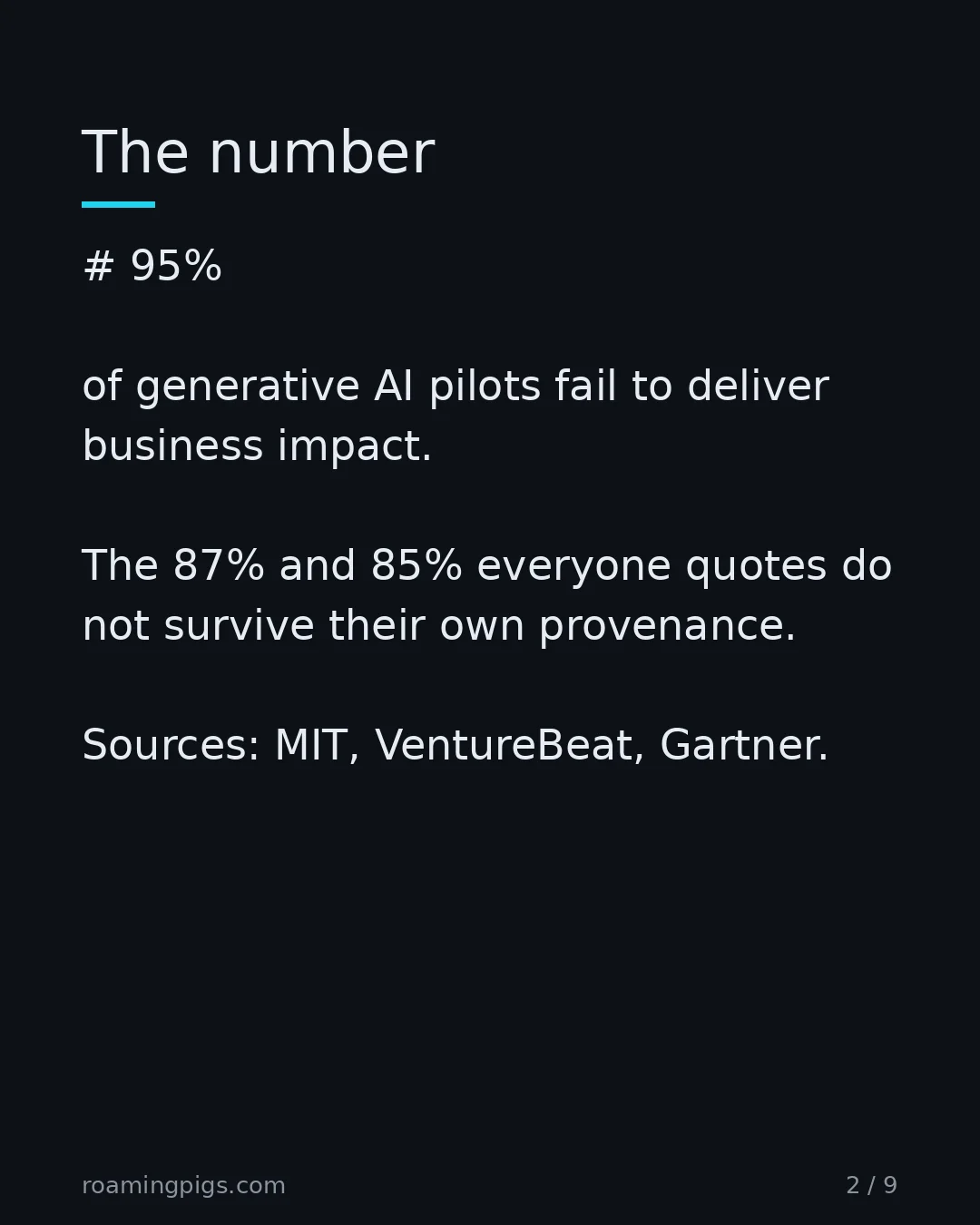
MIT's NANDA report found 95% of organisations getting zero return on generative AI. The two numbers everyone else quotes do not survive a look at their provenance. The 87% that never reach production traces back to an uncited trade-press article, with no study behind it. Gartner's 85% was a 2018 prediction that AI projects would deliver erroneous outcomes through 2022, not a measured failure rate, and it has been repeated into a statistic it never was. That is worth knowing before quoting either of them, and it is the same failure this piece is about: a number that ships to production without anyone checking it.
Source: MIT NANDA, State of AI in Business 2025. The 87% and 85% discussed above are deliberately not plotted: neither survives its own provenance.
The gap between these numbers and the AI hype is staggering. Vendors promise significant change. Analysts predict disruption. And yet, almost nothing actually works at scale.
2025 was supposed to be the "Year of the Agent." Autonomous systems handling sales, support, and development. What we got instead was what researchers call "Stalled Pilot Syndrome" - organizations running dozens of proofs-of-concept while failing to ship a single production system at scale.
The perpetual pilot became normal. Experimentation without real change. Budget consumed, engineering time burned, nothing to show for it.
Demo Conditions vs. Production Reality
The 2025 AI Agent Report identified the core problem: "The gap between a working demo and a reliable production system is where projects die."
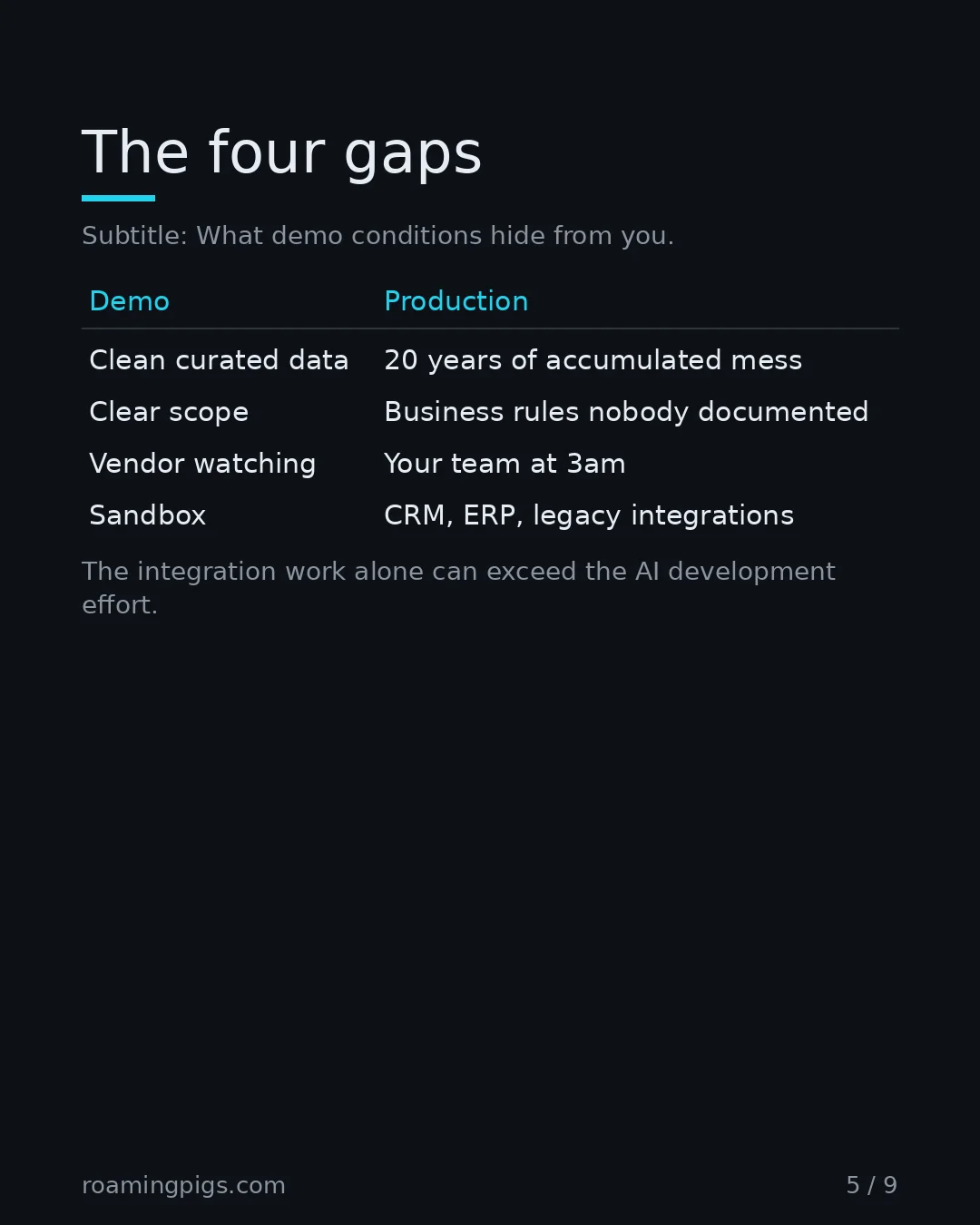
Demo conditions look nothing like production:
Clean data vs. messy data. Demos run on curated datasets. Production has decades of accumulated mess. Missing fields. Inconsistent formats. Edge cases nobody documented. The model that performed beautifully on clean examples chokes on real input.
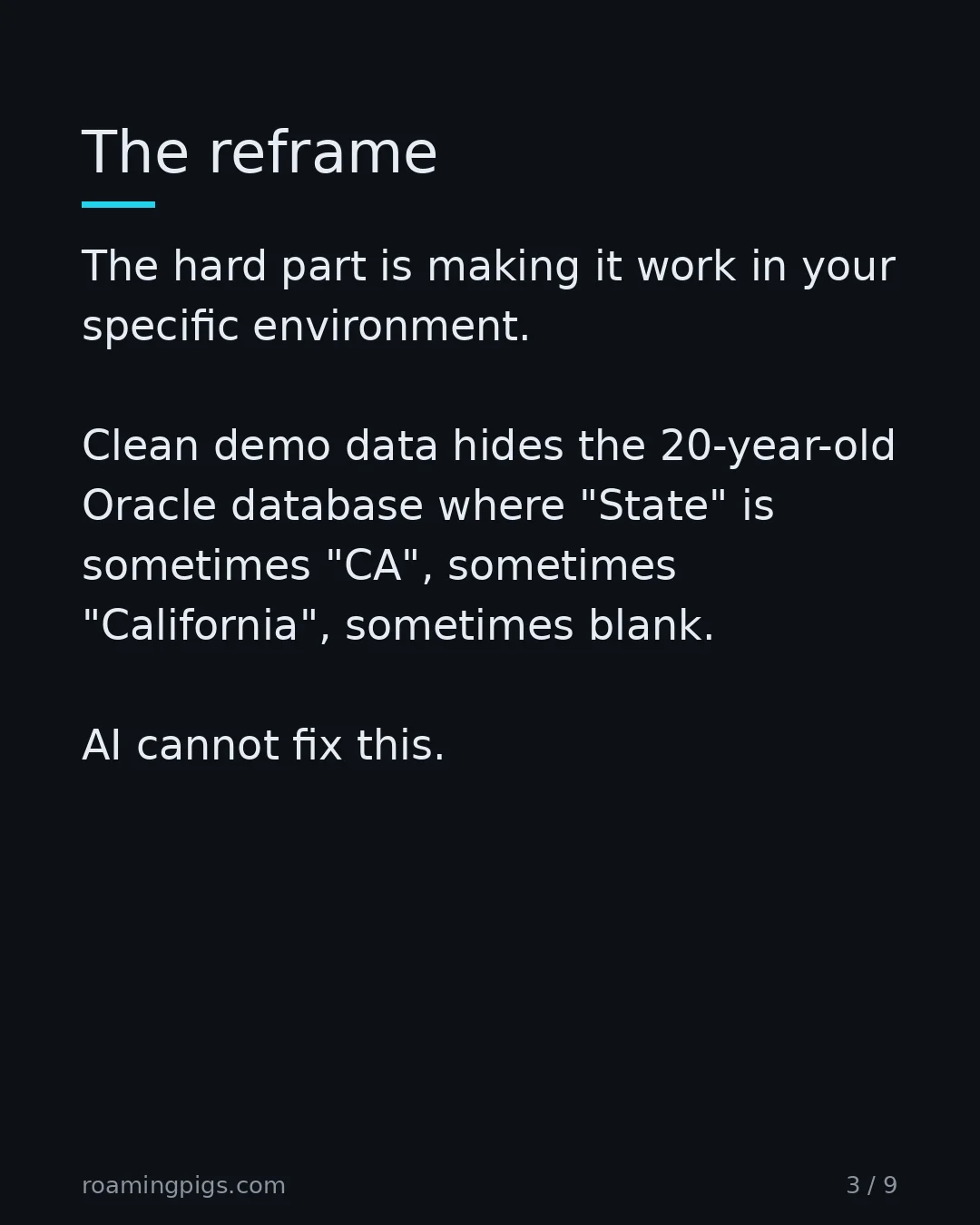
Your demo ran on clean CSVs. Your production data lives in a 20-year-old Oracle database where "State" is sometimes "CA", sometimes "California", sometimes "Cali", and sometimes blank. AI cannot fix this. You don't need a Data Scientist tweaking PyTorch hyperparameters; you need a Data Janitor writing dbt tests to catch nulls. And nobody wants to be a janitor—that's why the role doesn't exist.
Clear scope vs. complex requirements. Demos have obvious inputs and outputs. Production has business rules that evolved over years. Exceptions nobody remembers. Workflows that exist because someone important insisted, years ago.
Close supervision vs. autonomous operation. During pilots, vendor engineers watch closely. They catch errors, tune parameters, handle edge cases. In production, it's your team maintaining it at 3am when something breaks.
Controlled environment vs. system integration. Demos run in sandboxes. Production means integrating with CRM, ERP, databases, and systems that weren't designed for AI. The integration work alone can exceed the AI development effort.
The gap isn't a failure of technology. It's a failure to understand that the hard part was never making AI work. The hard part is making it work in your specific environment.
The Integration Bottleneck
The research is clear: "The biggest, most overlooked bottleneck is integration. It's not sexy, but it's what separates demos from production."
AI doesn't exist in isolation. To be useful, it needs to connect to your existing systems. It needs context from your databases. It needs to trigger actions in workflows that expect structured, deterministic inputs. But AI outputs are probabilistic. It's a collision between architectures. Your ERP relies on rigid transaction states; the LLM is a stateless probability engine. Bridging them requires complex orchestration—state machines that persist context when the model inevitably drifts. Demos hand-wave this away with "function calling" features that fail 5% of the time.
None of this exists in the demo. The demo shows the model answering questions. It doesn't show the six months of integration work required before those answers matter.
I've observed projects where the AI component took three months to develop and the integration took eighteen. The model was the easy part. Making it work with actual enterprise systems - that's where the time and money went.
And integration isn't a one-time cost. Systems change. Data schemas evolve. APIs get deprecated. The integration you built today breaks tomorrow. Maintenance is forever.
The Integration Tax Formula (1:4)
Stop budgeting for the model. Budget for the glue. After auditing dozens of failed pilots, I've found a consistent ratio: for every $1 you spend on the AI model (API costs, fine-tuning), you will spend $4 on the "Determinism Layer."
Why? Because your enterprise software is deterministic (it expects perfect inputs), but your AI is stochastic (it outputs probabilities).
The 1:4 Integration Tax:
- The Model: Generates a JSON object. (Cost: $1)
- The Tax: The regex parser to fix the broken JSON + the retry logic for when the schema drifts + the evaluation harness to catch when the "temperature" setting makes the bot hallucinate + the vector database re-indexing. (Cost: $4)
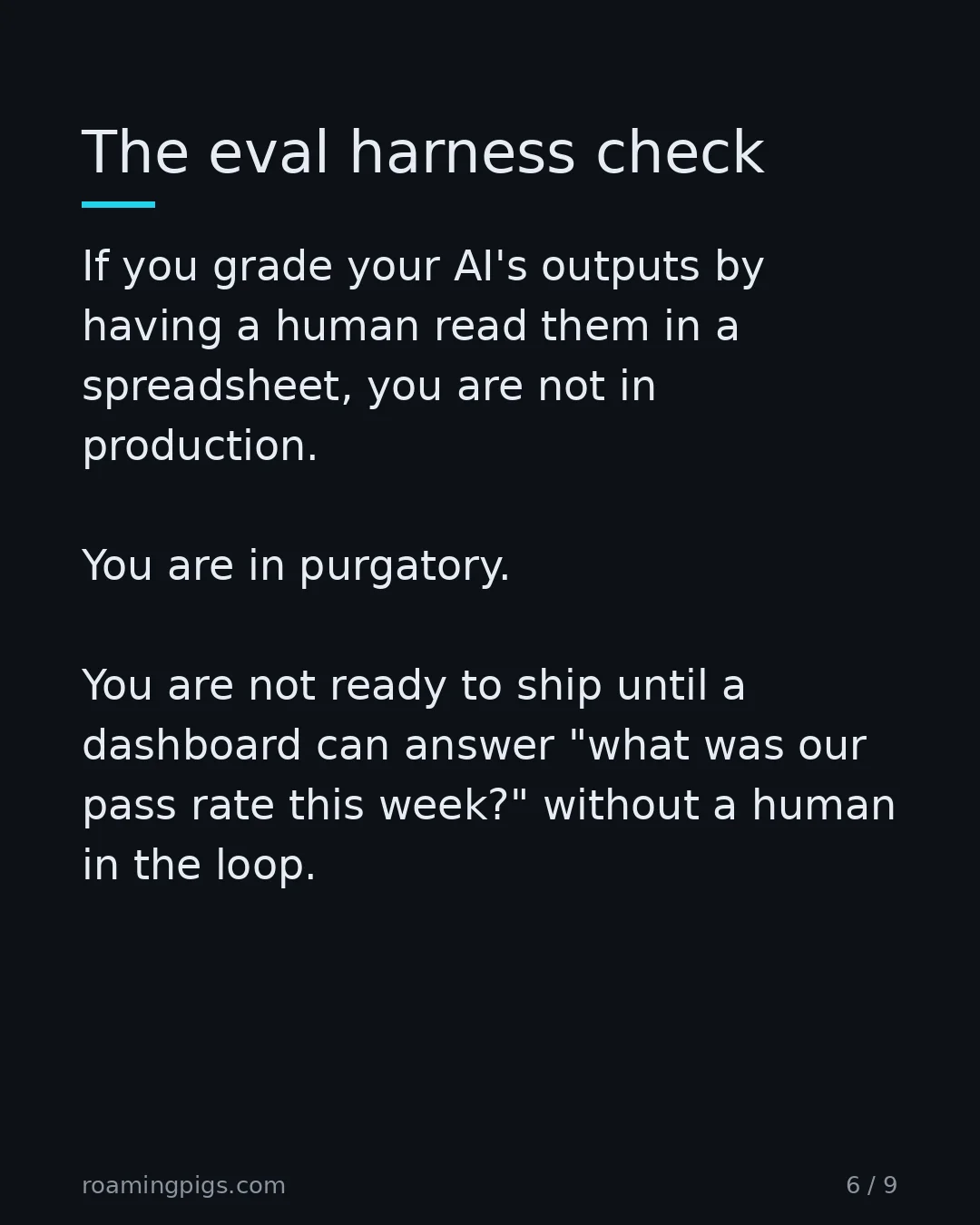
The Eval Harness Check: If you are grading your AI's outputs by having a human read them in a spreadsheet, you are not in production—you are in purgatory. You are not ready to ship until you have an automated evaluation harness that grades the AI without human intervention. If you can't answer "what's our pass rate this week?" with a number from a dashboard, you haven't built the infrastructure that production requires.
The Gap Visualizer
How clean is your production data? See how it affects your real timeline:
The Data Foundation Gap
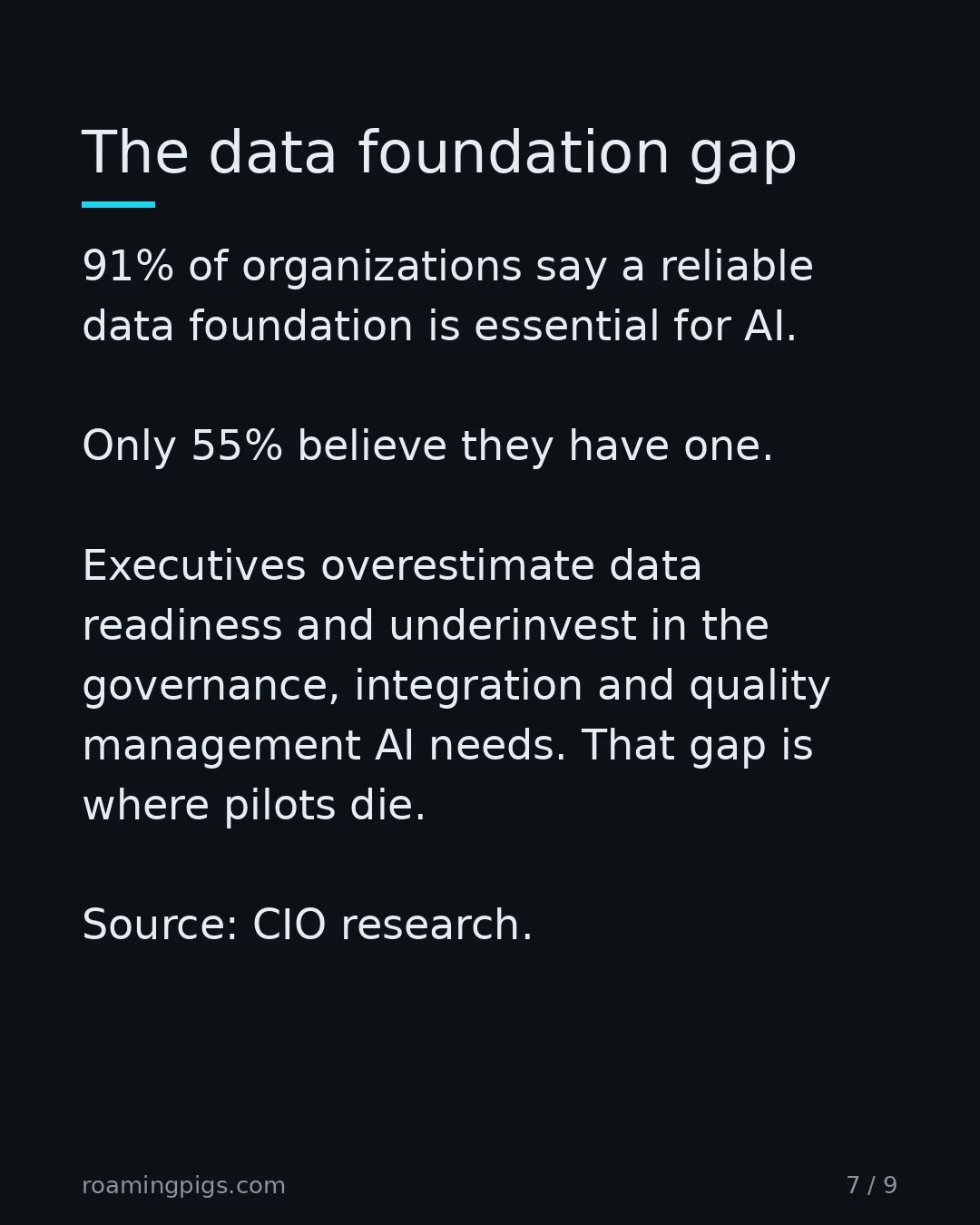
Research from CIO reveals a dangerous gap: 91% of organizations acknowledge a reliable data foundation is essential for AI success. Only 55% believe they actually have one. Executives overestimate data readiness while underinvesting in governance, integration, and quality management.
This gap is fatal. AI is only as good as the data it's trained on and operates with. If your data is fragmented, inconsistent, or incomplete, no amount of AI sophistication compensates.
The demo worked because demo data was clean. Production fails because production data is a mess. This isn't a surprise to anyone who's looked closely. But the surprise comes anyway, because nobody looked closely until production was attempted.
Data quality projects are boring. They don't make exciting demos. They don't get executive attention. So they don't get done, and AI projects fail.
FOMO-Driven Decision Making
The 2025 pilot rush wasn't driven by strategic clarity. It was driven by FOMO, vendor marketing, and the belief that experimentation itself constituted progress.
Every conference had keynotes about AI transformation. Every competitor announced an AI initiative. Every board asked "what's our AI strategy?" The pressure to do something was immense. Whether that something created value was secondary.
Pilots consume budget and engineering time. When they don't graduate to production, they create pilot fatigue. Teams lose faith that AI will ever move beyond demos. The next pilot starts with skepticism baked in.
This cycle is self-reinforcing. Failed pilots make future pilots harder. Organizations that rushed into AI experiments without strategy now face resistance to trying again. The failure patterns are predictable - but predicting them requires discipline that FOMO prevents.
The Learning System Problem
Most enterprise AI projects fail because they misunderstand "learning." The demo is a static snapshot of knowledge. Production requires adaptation. But here's the trap: LLMs do not learn from usage. They are frozen in time.
To make them "learn," you must build complex RAG pipelines or fine-tuning loops. If you automate this, you risk "data poisoning" where the model confidently absorbs errors. If you don't, the model rots. The demo ignored this lifecycle entirely.
As I've argued, LLMs aren't actually intelligent. They can't learn from your organization. They can't improve from corrections. They can't adapt to changing requirements. It hallucinates the same errors repeatedly because it has no mechanism for learning from mistakes.
Production systems need feedback loops. They need to get better from use. Without that, you're deploying a static tool that degrades in relevance over time. The demo that impressed you last year becomes obsolete this year.
Building learning systems is hard. It requires infrastructure for feedback collection, model updating, performance monitoring. Most pilots don't include any of this. They deploy a snapshot and hope it stays relevant.
The EU AI Act Deadline
Adding pressure to an already difficult situation: the bulk of the EU AI Act becomes applicable in August 2026, with the high-risk categories phased in after that. Companies that haven't figured out AI governance face compliance risk on top of competitive risk.
This isn't vague future regulation. It's a hard deadline. Demos don't need audit trails, explainability logs, or bias testing. Production systems under the EU AI Act do. That "governance layer" often costs more to build than the AI itself.
The companies that successfully deployed AI in 2024-2025 have time to adapt. The companies still in perpetual pilot mode will face compliance requirements for systems that don't even exist yet. The gap between leaders and laggards is about to widen.
What Success Actually Requires
The 5% that succeed share common characteristics:
Problem-first thinking. They start with a specific, quantified business problem - not "how can we use AI?" The technology is a solution to something concrete.
Production planning from day one. Integration requirements, security review, operational support, change management - all scoped before the pilot begins. The pilot is phase one of deployment, not a separate experiment.
Internal capability building. They don't outsource everything to vendors. They build organizational muscle for AI deployment. When the vendor leaves, they can operate independently.
Data foundation investment. Before attempting AI, they invest in data quality, governance, and integration. The boring work that makes the exciting work possible.
Realistic timelines. They plan for 12-18 months from pilot to production, not 6. They budget for the integration work that always takes longer than expected.
Production Readiness Scorecard
Score your AI initiative before committing to production. Low scores predict the gap will kill you.
| Dimension | Score 0 (Not Ready) | Score 1 (At Risk) | Score 2 (Ready) |
|---|---|---|---|
| Data Foundation | No data governance | Some cleanup done | Clean, governed, integrated |
| Integration Plan | Undefined | High-level timeline | Detailed with 4x budget |
| Eval Harness | Human spreadsheet review | Partial automation | Automated pass/fail dashboard |
| Internal Capability | 100% vendor-dependent | Some knowledge transfer | Can operate without vendor |
| Success Metrics | "Make it better" | Defined KPIs | Baseline + targets + owners |
| Failure Handling | No plan | Escalation defined | Automated fallback + SLA |
What your score means
- 0–3: Stop.
- 4–7: Address gaps before production commitment.
- 8–12: You've done the boring work.
AI Production Readiness Assessment
| Gate | Ready | Not Ready |
|---|---|---|
| 1. Problem Definition | Specific metric to move, baseline measured | "Explore AI opportunities" |
| 2. Data Foundation | Clean, accessible, documented data | Scattered across systems, quality unknown |
| 3. Integration Path | APIs identified, security reviewed, timeline scoped | "We'll figure it out after the demo" |
| 4. Operational Plan | Team trained, monitoring in place, escalation defined | Vendor will handle it |
| 5. Success Criteria | ROI threshold, kill criteria, decision date | "We'll know it when we see it" |
Before Your Next AI Pilot
- This week: Write down the specific business metric your AI pilot is supposed to move. If you can't name one, pause the project
- This month: Audit your data quality for the pilot domain. If data cleanup would take longer than the AI work, do that first
- Ongoing: Budget integration time at 3x your estimate. Every AI project that failed underestimated this
The Bottom Line
The demo-to-production gap isn't a technology problem. It's a planning problem. Organizations underestimate the distance between "AI can work" and "AI works in our environment."
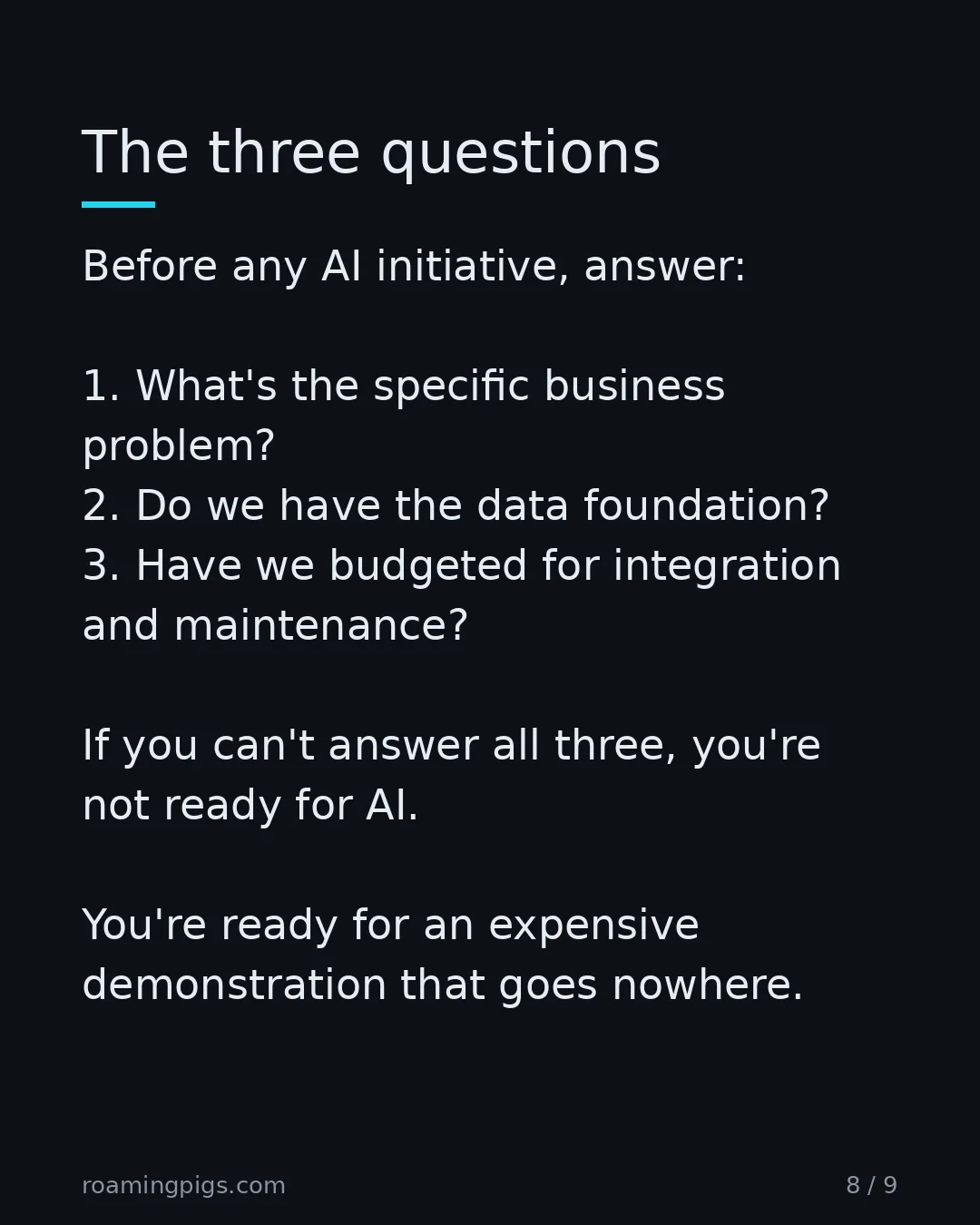
Before starting any AI initiative, ask three questions: What's the specific business problem? Do we have the data foundation? Have we budgeted for integration and maintenance?
If you can't answer all three, you're not ready for AI deployment. You're ready for an expensive demonstration that goes nowhere. The organisations getting nothing back share a common trait: they started the demo before answering these questions.
"The gap between a working demo and a reliable production system is where projects die."
Sources
- S&P Global — 42% of companies scrap majority of AI initiatives before production
- MIT: State of AI in Business — External partnerships reached deployment ~67% of the time against ~33% for internally built tools, self-reported per the report's own caveat; 95% of organizations getting zero return.
- CIO Research — 91% acknowledge data foundation is essential; only 55% have one
- 2025 AI Agent Report — Integration identified as biggest bottleneck; "Stalled Pilot Syndrome" as dominant failure mode

Building Something That Works?
If you're shipping AI that actually delivers value, tell me what's different about your approach.
Send a Reply →